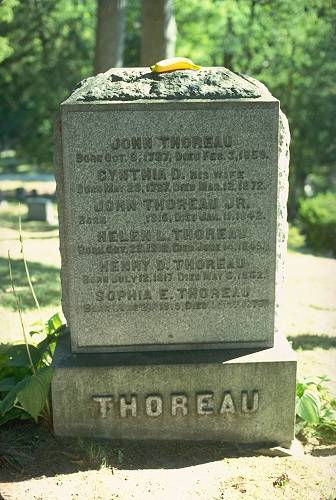
Henry David Thoreau
Sleepy Hollow Cemetery
Concord, Massachusetts
Henry David Thoreau
Sleepy Hollow Cemetery
Concord, Massachusetts
Thoreau’s very famous and very influential 1848 essay, Civil Disobedience, is available in the 101 Bananas Scholar’s Library section. You can read it HERE.
“I would rather sit on a pumpkin and have it all to myself, than be crowded on a velvet cushion.”
* * *
“The greater part of what my neighbors call good I believe in my soul to be bad, and if I repent of anything, it is very likely to be my good behavior.”
* * *
“If I knew for a certainty that a man was coming to my house with the conscious design of doing me good, I should run for my life.”
—Henry David Thoreau
An imaginary Thoreau appears on an imaginary television talk show...
by Lucius Furius
Henry on a mid-19th-century talk show....
[AB=Ainsworth Brown; HDT=Henry David Thoreau]
AB: Good afternoon. This is “The Ainsworth Brown Show” and I am Ainsworth Brown. We are privileged to have as our guest this afternoon Henry David Thoreau who has written a book, Walden; or, Life in the Woods. Henry, come on out....
[Applause from studio audience as Thoreau enters]
Welcome, welcome. Glad you could come... Have a seat....
HDT: Thank you.
AB: Henry, I have not had a chance to read your book yet but I do know that it is, in the popular parlance, “hot, hot, hot.” Graham’s Magazine has called it “always racy and stimulating,” the product of a “powerful and accomplished mind”... So what’s this Walden about?
HDT: It’s the story of the two years, two months, and two days I spent living alone in a cabin by Walden Pond, near Concord, Massachusetts.
AB: What happened?
HDT: I built the cabin. That first summer I grew some beans as a cash crop. In the book I talk about the food I ate, the plants and animals I saw, and the changing of the seasons.
AB: So what did you eat?
HDT: I ate wild berries and grapes. I occasionally caught some fish or a wild animal—I once trapped and butchered a woodchuck who was bothering my bean plants—but mostly I ate rice, bread made from rye and cornmeal with molasses as sweetening, potatoes, and peas.
AB: Frankly, Henry, except for the woodchuck, it sounds pretty boring.
HDT: I can see why you might think so, Mr. Brown. But, as I contend in the book, the external circumstances in which one finds one’s self are far less important than one’s inner life. I wanted to simplify my material needs to a point where I could spend just a few hours each day satisfying them and have all the rest of my time free for contemplation and self-improvement. Most men are slaves to their possessions and to the jobs they are forced to perform in order to pay for them.
AB: I get it—a Marxist/capitalist kind of thing....
HDT: I’m not sure I know what you mean....
AB: What were the results of your contemplations?
HDT: I have recorded many of my thoughts in the book, but I don’t really think of contemplation as a means for book-creation, or as a means to anything at all, but rather as an end in itself.
AB: I see... so it’s like meditation, TM, that kind of thing....
HDT: Yes, it is meditation.
AB: But you would meditate for like—what—ten hours a day?
HDT: Yes, it might frequently have been that long.
AB: Wow! Did you spend all your time at the pond or did you go other places too?
HDT: I have always walked wherever I’ve wanted to. Individual men may think they own particular pieces of property but, in a truer sense, trees, mountains and animals cannot be owned; they belong to Nature and to the men who would love and protect them.
AB: [Turning to camera] So, there you have it. Henry David Thoreau, Marxist eco-warrior. He has regularly spent ten hours a day in meditation and once killed, butchered with his own hands, and ate a woodchuck who was devouring his bean plants. His book [holding a copy up to the camera] is Walden; or, Life in the Woods. Thank you, Henry. Please tune in tomorrow when my guest will be....
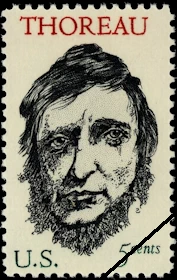
U.S. postage stamp honoring
Henry David Thoreau, issued in 1967